The Winter Cartographer

The cartography, writing, and ramblings of one crazy winter lover who likes to blog about the fun and inconsequential.

Showing posts with label cartography. Show all posts
PNG

The 2004 Democratic Primary


The 2004 Democratic Primary was defined by its opposition to the policies of President George W. Bush, particularly in the economy and over the Iraq War. Initially, former Governor of Vermont Howard Dean, known for his centrist policy record as Governor, led the primary both in polling and in fundraising through populist fervor. His campaign also was innovative in using the internet to raise donations, a tactic that would only increase until it became one of the top ways to fund campaigns by the 2020 primary.

Going into Iowa, Howard Dean and Congressman Dick Gephardt were the expected leaders for the caucus, but just before the caucus was held Massachusetts Senator John Kerry, favored by the establishment, and upstart Senator John Edwards of North Carolina surged ahead, eventually coming in the top two places in Iowa. Kerry then won New Hampshire and from there proceeded to dominate the primaries and get the backing of the Democratic Party. Edwards managed to come close in several states, notably Wisconsin, as well as win the Carolinas, but ultimately could not stop Kerry from becoming the nominee.

The other interesting bit from the 2004 Democratic Primary is the candidacy of Retired General Wesley Clark. The last of the ultimately 10 candidates to enter, Clark was part of a draft campaign that sought to get an antiwar general into the primary as a way of offsetting George W. Bush's popularity following 9/11. While initially showing strong support, Clark's campaign had media troubles from the start that would cause his candidacy to fail, even as he managed to carry the Oklahoma Primary.


PNG 1 | 2

The 2004 Presidential Election


The 2004 Presidential Election featured John Kerry, with primary runner-up John Edwards as his running mate, facing off against the then-popular George W. Bush in a battle for control of the country. The campaigns came to focus squarely on issues related to 9/11, as the attacks cast a long shadow over the campaign, along with the resulting wars in Iraq and Afghanistan. Conservative voters focused on a strong leader against terrorism while liberal voters wanted a strong leader for the Iraq situation.

Military records in particular for both candidates famously were scrutinized. When Bush's record with the Texas Air National Guard was looked into by CBS less than successfully, major leadership changes and firings occurred over the uproar resulting from the way they handled the investigation. Perhaps most infamously was the work Swift Vets and POWs for Truth did to cast Kerry in a negative light in questioning his service and his discharge from the US Navy. "Swifboating" became a term used in elections after this, used to mean a candidate is treated harshly and personally in an unfair manner. Ultimately, Kerry's Swiftboating was far more successful on the Republican side.

While the debates went better for Kerry, the Bush campaign and Bush's latent popularity were enough to help push him over the top when it came time for the election. It also helped that the terrorist most wanted for the 9/11 attacks, Osama Bin Laden, released a video just days before the election mocking the United States and Bush, which gave Bush more of a lead. While Kerry would still keep the election close (close enough that a few more percentage points in Ohio would have won him the election), Bush won the election both in the electoral vote and popular vote. This marks the only election since 1988 in which the Republican candidate has won the popular vote.

Thank you all for reading! Next up in January is 2008 and maybe some stuff on Senate, House, and Governor races!

The 2000 Democratic Primary

The 2000 Democratic Primary  is fascinating for a number of reasons. For one, it is interesting for the total domination of Al Gore in the primary, as it marks the last time a non-incumbent candidate won every single state in the Democratic Primary. Then-Vice President Gore managed to create perhaps the most wide-ranging coalition in the primary in the 2000s, a far cry from the later more divided primaries. 

His main opponent was former Senator and ex-NBA player Bill Bradley, who ran a campaign to the left of him on issues such as education and healthcare. Despite comparable fund-raising and strong endorsements, Bradley could not come close to competing with the then-Vice President under a popular Democratic President and dropped out after Super Tuesday.

The other notable inclusion is that of cult leader Lyndon LaRouche. While overall a failure, LaRouche received large amounts of votes in some places such as Arkansas, where he garnered one-fifth of the primary vote. 

The 2000 Republican Primary

The Republican Primary in 2000 for President was a markedly more competitive one than the Democratic competition. While George W. Bush, son of former President George Bush, then-Governor of Texas, would go on to win in a comparative landslide, the primary began with real competition. That competition largely came in the form of Senator John McCain of Arizona, propelled to the national stage when he was shot down as a pilot in Vietnam, captured, and later released to much fanfare. McCain would run a dark horse campaign, riding a bus around the country to "straight talk" America and decry the religious right while Bush stuck to his idea of "compassionate conservatism" that courted the further right wing of the party. 

After Bush won Iowa and McCain swept New Hampshire, the primary came to a head in South Carolina. There, Bush engaged in infamous racist attacks on McCain, alleging the Senator had had a child with a black prostitute, rather than adopted a child from Bangladesh as was the case. The attacks seemed to help, and Bush won South Carolina by 9% and McCain's campaign struggled. Though he won several contests after, including his home state of Arizona, most of New England, and Michigan, Bush swept the primaries he needed and McCain dropped out, guaranteeing Bush the winner.

The 2000 primary is also notable for having a few national faces. Steve Forbes, editor-in-chief of Forbes magazine would run and perform relatively well in Iowa, though nowhere else. Alan Keyes, formerly of the Reagan Administration, would run again in 2000 after losing in 1996. Alan Keyes would become a perennial candidate for Republicans across the nation, running in Maryland later and then again in 2004 against one Barack Obama for the Senate seat which Obama would use to catapult himself to the Presidency.


PNG 1 | 2

The 2000 Presidential Election

Before Trump, before locker room talk, before James Comey and private email servers, before Russia (well, before Russiagate anyway not the country...you know what I mean), there was the 2000 Presidential Election.

Coming off the heels of President Clinton's failed impeachment as he left office more popular than he had ever been, the 2000 Presidential Election presented a moral battle between two giants: Texas Governor George W. Bush and Vice President Al Gore. Gore sought to distance himself from President Clinton's past misdeeds and sought to carve his own path while Bush campaigned on restoring dignity to the White House and on "compassionate conservatism".

But more than that, 2000 is remembered for the nastier side of politics. For the media blitz that came to define politics afterwards, with many Gore supporters alleging that the media exaggerated claims about Gore (similar claims would be made about Clinton in 2016). For the aggressive campaigning that would become the norm of elections in the 21st century. Even for the color coding of the candidates themselves, as this is the election in which red for Republicans and blue for Democrats was truly set in stone, a fact that is now taken for granted.

Of course, what most remember 2000 for is the razor-thin win Bush in Florida after a media and political frenzy over recounts (later examinations show that recounts in the few counties ordered would not tip the election to Gore but in all counties would have given the election to Gore). Political activists and fixers such as Roger Stone swarmed Florida and the Supreme Court got involved to order a stop to the recount. Even members of Congress at first refused to certify the results until ruled out of order. It's a controversy that carries on to this day, even if now replaced by controversies over the 2016 Presidential Election, which I'll get to later...

In the end, Gore was declared the loser. In many ways, he was lucky to come so close, winning 4 states by less than 1% as the nation shifted heavily to Bush from 1996 to 2000. This would be the beginning of the current order of politics as Democrats were chased out of southern states like Louisiana, Arkansas, and Missouri that Clinton had won twice and, as of 2019, are not anywhere close to being won by Democrats again. At the same time, this was near the end of the era for a Republican to win major cities, like Marion County, Indiana (Indianapolis), Dallas County, Texas, Mecklenburg County, North Carolina (Charlotte), and so forth. 

It was the end of the last political era and the beginning of a new one, which I will cover in further maps that I hope you'll all find interesting. Thank you for reading.


PNG link 1 | 2 | 3

Hello everyone, at last I've finished the main map for Alabama in the little series I've been posting on here. I hope you all enjoy it, it was a doozy to do but I had a lot of fun with it! I hope to do more state maps like Dakota and Sequoyah from this world in the future, too. What follows is the history of Alabama in this world I'm making, which should hopefully give some nice backstory to the world and give more information for later installments!


Alabama is a state that owes its history to Reconstruction following the Civil War. With the deaths of President Lincoln and Vice President Johnson, Radical Republicans were able to make acting President Lafayette Foster their puppet and get what they wanted for their plans in the South. With this "Radical Reconstruction", Republicans sought to break the back of slave power's remnant in the South following the Civil War. Former Confederates were punished and disallowed from office, civil rights bills were enacted, Amendments to the Supreme Court passed, and locally in Alabama a large branch of the Freedmen's Bureau was set up in Huntsville.

Alabama was not without resistance to the new policies, but the continued elections of Radical Republicans in Congress and to the Presidency, like President William H. Seward, meant that the government stood firm. Republicans were able to solidly carry the vote in Alabama throughout this era due to a diverse political alliance centered among the newly-freed and empowered black population. By the 1880s, Alabama had elected its first black Governor: Charles Atwood, a former slave who worked his way into being a notable investor in and ally to the powerful Pratt Coal & Iron Company in Birmingham.

The two primary political forces that would continue to dominate Alabama would be industrial production in urban centers such as Birmingham and Mobile and agricultural production throughout the rest of the state, but particularly in the "black belt" region where freedmen farmers made use of Radical Reconstruction to form their own organizations and cooperatives. The Southern Farmer's Alliance would do well here, and help form half of the political alliance that would morph into the modern Farmer-Republican Party. Alabama's urban centers would boom around the turn of the 20th century as Birmingham Steel and Mobile Shipbuilding became mainstays of the United States economy, and the state prospered.

Alabama was relatively unharmed by the "Troubles" of the 1930s in the United States, the period of social unrest and rebellion throughout the South against the American government, particularly by the descendants of anti-Reconstruction "Redeemers". The worst troubles was in Appalachian Alabama, but the already-heavy military presence in Alabama, with a large Army base in Anniston, made sure to keep things under control. Alabama would then see its economy boom during the 1940s following the United States' entry into the Global Revolutionary Wars, as Alabama's factories, shipyards, and mines worked just around the clock to provide the nation with its arsenal.

Following the war, Alabama began its transition to a modern economy, as cities like Montgomery, Auburn, Huntsville, and Tuscaloosa began to rise as centers of the educated and professional business while Mobile and Birmingham began to diversify their economies away from their industrial pasts. Suburbanization occurred to an extent, and the cities expanded their borders to allow residents to live outside of the downtown areas while still within city borders. New highways moved through Alabama and the AFRA (American Federal Rail Authority) extended its lines through the state.

Many rural Alabamians packed up and moved to the state's cities or to the ever-growing Steel Belt in the North. This rural movement helped create conflict in many areas, and began movements on the subjects of labor and particularly race throughout the United States. Civil rights leaders in states such as Michigan, Illinois, and Ohio hailed from Alabama and brought their values with them as they sought to make life better in their new homes, while other leaders fought for labor, marriage, and other rights at home in Montgomery, Huntsville, Birmingham, and Mobile. Young black leaders were elected to local and, later, statewide positions as a result of these movements throughout the 1960s and 70s.

Today, Alabama is a growing state of just over 5 million with a large, multi-faceted economy and comparable living standards to the rest of the South. It is a complicated and diverse state, from the co-op farm fields to the bustling modern high-tech offices in Birmingham and everything in between. Politically it is divided between the three parties, and its future is uncertain over which will emerge victorious over the state. The Farmer-Republican Party, the broad tent party that has formed a union between much of rural and small town Alabama for generations, has slipped from its domination. The Social Democratic Party has come to power in heavily-educated and dense-populated areas of the state as well as reaching out to landless farm workers who derisively refer to the old party as the "Planter-Republican Party". In the suburbs and struggling white rural farms and small towns the right-populist American Worker's Party has grown as well on a message of economic strength for the little man and conservative values, met derisively by both other parties.

As mines close and factories fight with unions about closures, the economic future of Alabama is also up in the air. The state is in many ways a meeting place, where the Deep South states that straddle the Mississippi meet the Atlantic South. Whichever way Alabama goes in the future, so too will the other Reconstructed States of today go as well.

Full size JPG | PNG

Note: the write-up below is an editorial reflecting the views of the artist

The 1892 Presidential Election is perhaps best remembered for Grover Cleveland's comeback to the Presidency, but it was far more than that to the people of the time. Against a flawed incumbent President Benjamin Harrison, several major movements gained a boost in popularity in this election. In particular, this election would mark the peak of the People's Party at the Presidential level.

The People's Party was a largely agrarian and rural party formed by groups such as the National Grange of the Order of Patrons of Husbandry, Farmers' Alliances, and the Knights of Labor. Also known as the Populist Party, the People's Party supported stances such as bimetallism (tying American currency to both gold and silver rather than just gold), collective bargaining, federal regulation of railroad rates, a graduated income tax, direct election of Senators, and more.

The Populists were most popular in the agrarian West, but also had a measure of popularity in the South by running "fusion" tickets in place of Republicans, to try and break the absolute hold the Democratic Party had on the south since the end of Reconstruction. Both movements within the party would be successful, though later become polarized against each other and help lead to the party's downfall. The party would cast its lot in by endorsing William Jennings Bryan in 1896 and 1900, which proved unsuccessful in getting a People's Party candidate elected to the Presidency. However, many of the platform issues the People's Party endorsed would later be passed.

Back to 1892, the People's Party performed very well among the restless Gilded Age electorate, but failed to garner support in the Midwest despite the support of labor organizers like Eugene Debs. This has been chalked up due to the divides in priorities from Midwestern and Northeast labor, largely urban, and the more rural and agrarian labor that was the People's Party bread and butter in the Great Plains and West. In particular was the issue on tariffs that could hurt farmers and help urban laborers.

The tariff was a particularly big campaign issue, dating back to the 1890 McKinley Tariff. Cleveland called for lowering it while Harrison, obviously, supported it. The tariff was steep and it divided states and laborers, as said, in the west and the east between those who desperately wanted it lowered and those who wanted to keep it. Not to be outdone on just economic issues, though, civil rights was part of the campaign as well. Though the fight is often papered over now, Harrison supported a bill called the Lodge Force Bill, which would have allowed federal circuit courts to appoint election supervisors if a relatively small number of locals petitioned for it. This would have helped the black voting population in the South, but it stalled in congress and Cleveland became President so it didn't happen. And, well, that really sucks. There's not really a way to sugarcoat that.

In the end, Cleveland won, was unable to handle popular pressures bubbling beneath the grimy surface of the Gilded Age (Pullman Strikers Forever), and then the economy collapsed and only one Democrat would be President from 1896 all the way until 1932. He left office massively unpopular and alienated most of his party. One thinks Cleveland would have been better off stopping at one term, perhaps. As said, the People's Party would endorse progressive reformer William Jennings Bryan in 1892 and 1896 before fading away but getting their platform largely passed in a victory of sorts. The Prohibition Party, who got a respectable number of votes in 1892 as well, would see their own victory with the Eighteenth Amendment to the Constitution in 1920, though that wouldn't go over so well and be repealed in 1933. The end.

Citations


Jeffrey B. Lewis, Brandon DeVine, Lincoln Pitcher, and Kenneth C. Martis. (2013) Digital Boundary Definitions of United States Congressional Districts, 1789-2012. Retrieved from http://cdmaps.polisci.ucla.edu on 2 September, 2018.

Haynes, Stan M, and Stan M Haynes. “Preface.” President-Making in the Gilded Age: The Nominating Conventions of 1876-1900, McFarland & Company, Inc., 2016, pp. 2–2.


Link to PNG

Hello, all! Here is my latest map. I can’t say the entire background, as it is for a larger story I want to tell in the form of a timeline posted on my Patreon and here as well called Spurious Transmissions: Tales From Another World. But for now, I will give the backstory.

Essentially, a slightly less turbulent early administration of Ulysses S. Grant but problems later in his second term cause Grant early on to not consider running in 1876. A number of men jump in for the Republican nomination, but eventually it is Benjamin Bristow who emerges victorious. He runs on an administration-critical ticket of economic populism and support of Reconstruction that gives him an edge that Hayes never had, and he wins 1876 handily with promises of a new, fresh start on the economy. He also is willing to apply pressure on the states not finished Reconstructing, namely South Carolina, Florida, and Louisiana. He is unwilling to let the states fall and indeed in 1876 through 1877 all three states see Republicans re-elected and federal troops stepping in against violence.

Bristow’s willingness to use the powers at his will to enforce Reconstruction and Republicans recapturing the House so as to control all houses of federal government causes a shift in the south. Slowly at first but growing over time, “Redeemer” whites leave the three states for other southern states in which the local rule is more friendly, if not as harsh as our own world due to federal intervention. Similarly, northern whites living in the south and freedmen move in increasing numbers to these three states, effectively transferring populations over time. For a time, this keeps the peace and Bristow goes on to win a second term as economic difficulties subside by 1880.

There is lots more to this world and events that come after to make it different from our own, but that is where it starts, and hopefully it will be a world y’all will enjoy reading about. I also hope all y’all enjoy the map and feel free to ask questions about it!

Full Size | PNG

"My friends, to those who say that we are rushing this issue of civil rights, I say to them we are 172 years late. To those who say that this civil-rights program is an infringement on states’ rights, I say this: The time has arrived in America for the Democratic Party to get out of the shadow of states' rights and to walk forthrightly into the bright sunshine of human rights. People -- human beings -- this is the issue of the 20th century. People of all kinds -- all sorts of people -- and these people are looking to America for leadership, and they’re looking to America for precept and example." - Hubert Humphrey, July 14, 1948

The Heartland. Over a million square miles of rolling hills, windswept plains, and sleepy suburban towns snaking their way to glowing urban centers. Mythologized in American culture: from Fly-Over Country to Middle America, the qualities projected on the vast land between the oceans reflect as much on those doing the projecting as the land itself. And once, there was a man who made that land believe in him and won another four years in the White House off of them.

How does one describe Harry S. Truman? He, like yours truly, made his way in this world without a college degree. He worked odd jobs and slept in hobo camps before later becoming an artillery officer in the First World War, a judge, and from that a Senator from Missouri. He had only met FDR twice before Roosevelt died in office and he was tasked with helping end the largest war in human history. A man whose only war experience was as an artillery lieutenant and with no formal education had to choose whether to use atomic weapons on two cities in Japan. I don't know if he made the right decision. I don't know. I wasn't there, I don't know everything, and I don't imagine he did either. He may have been, in fact, the closest a normal person's got to the Presidency in recent history, and did so right as the Cold War kicked off. The most normal President in modern history given choices about spying on American citizens, the blockade of Berlin, and how to make a policy around the use of nuclear weapons. Hell.

Then came the 1948 Presidential Election. Thomas Dewey, who had run against Franklin Roosevelt in 1944 and given him a run for his money even for a popular President in wartime, was the Republican nominee and polls looked grim for Truman. Republicans had taken back Congress in 1946 for the first time since the Great Depression started, and Republicans in Congress were giving Harry a hard time. Truman's approval rating hit 36 percent and he got the nomination only because General Eisenhower refused to take it, and then came the Democratic National Convention.

There, a tepid pro-civil rights plank became a more fiery acceptance of civil rights thanks to then-Minneapolis Mayor Hubert Humphrey, whose headlining speech adorns this page. Truman backed the rhetoric and attacked Republicans on cutting services, welfare, unions, and for being a "Do Nothing Congress". Cheers erupted at the convention hall for the most part, while southern delegates from Mississippi and Alabama walked out in protest. Not long after, coupled with Truman integrating the armed forces and the federal agencies, South Carolina Governor Strom Thurmond announced he'd run a campaign to the right of President Truman in the Democratic Party, calling it a campaign for States' Rights, while of course focusing mostly on the right of states to refuse civil rights reforms and keep their precious segregation and bigotry. Not to be outdone, former Vice President Henry Wallace re-formed the Progressive Party to run to Truman's left on social and labor issues. Truman's poor handling of the mass strikes of 1946 in particular was a prime example of where Wallace wanted to hit him, traveling around the country preaching a more radical vision of politics.

So that's when Harry started the famous tour that likely helped save his Presidency. He took a train around the country, several thousand miles, and began holding campaign stops in every little town in the country. Most of these folks had never seen the President before; just heard him on the radio or read about him in the newspaper. Truman understood that. He understood that being able to face these people in person and deliver his message right to them from the back of a train car, he could win them over; maybe not all of them, but enough to matter. He talked to farmers, miners, laborers, and all the everyday people from coast to coast. 

Dewey was no slouch either, traveling around the country himself to make big speeches, but where Truman's crowds got more enthusiastic with cries of "Give 'em hell, Harry!", Dewey's got weaker. No matter the polls or the pundits, the outcome could be felt in the air. A good politician knows it, too. The way the country moves and people feel, the way the faces will look back at you and voices lift you up. You all know the famous newspaper declaring Dewey the preemptive winner, but it's hard not to believe that those truly connected to the campaigns didn't have an inkling of what was to come beforehand.

In the end, Harry Truman united a strange coalition Democrats have not seen since. While Republicans under Dewey returned to their strengths in the Northeast, winning New York, Pennsylvania, New Jersey, and so forth, Harry Truman swept much of America's Heartland, from Appalachia to the Mountain West. He is one of only two Democratic Presidents to ever win without both Pennsylvania and New York, and the only one to do it without the entire south backing him, as four states cast their votes for Strom Thurmond instead. To boot, Congress swung back for Democrats as well on Truman's coattails as 75 seats in the House of Representatives flipped in favor of his party and sent many new Republicans packing. It was a greater victory than the party could have hoped for, and set the one on coalitions and civil rights for the next half-century to come.

Harry S. Truman wasn't a perfect man. I'm sure there are those reading this who don't believe he was a good man, to put it mildly. This essay is not a judgement of his moral character, but rather a simple recounting of an election unique in the 20th century, about a surprisingly ordinary man in an extraordinary office who managed to win it in a very unusual way. A Kansas City lawyer took an era and Presidency turned against him and won Flyover Country, Middle America, and Small Town USA in a way that a Democrat has not been done since, and I think that's worth a mention.


Full Size | PNG

"I would remind you that extremism in the defense of liberty is no vice. And let me remind you also that moderation in the pursuit of justice is no virtue." -Barry M. Goldwater, July 17, 1964.

The trio of Presidential elections in the 1920s are best remembered for how uneventfully overwhelming the victories were for the Republican Party, as the oft-glamorized Roaring Twenties handed Republicans three straight victories in 1920, 1924, and 1928. It's too easy to lose these three elections in the flappers, jazz, and runaway markets of the era as names like Harding, Coolidge, Davis, Cox, and so forth become trivia points (how many before today that Franklin D. Roosevelt ran as James M. Cox's running mate for Vice President in 1920, 12 years before he successfully ran for President?). 1924 is, by extension, the height of electoral anonymity, featuring a President best known for saying as few words as possible and two other candidates largely passed into history except for those of us, such as yours truly, with a vested interest in the subject.

But every election as big as President matters to the people at the time, and their effects ring out long after the candidates and figures have been forgotten.

In 1924, Calvin Coolidge and the Republican Party had returned to a height of power lost during the Wilsonian years but gained following the end of the First World War and the small recession resulting from it. The economy was improving rapidly, the average American's lifestyle was climbing higher, and the Democratic Party was on the retreat. Even after the Teapot Dome scandal under President Harding, the Republicans had recovered in part due to the President's death and thus the assumption of the Presidency by Coolidge. But within, the party and the country itself broiled with conflict.

Race riots, bombings, and lynchings were still common in the 1920s as the Ku Klux Klan rose to prominence under new the new leadership of William J. Simmons following the 1915 release of Birth of a Nation (helpfully screened in the White House by President Woodrow Wilson, the fucker), and by 1924 reached a membership peak of 1.5 to 4 million members, between 4 and 15% of the eligible population. Besides being anti-black in their bigotry, the Klan focused on anti-Catholic, anti-Jewish, anti-Communist, and anti-immigrant campaigns as well as those who pushed against Prohibition and for the sexual openness that the Roaring Twenties are known for today. In 1921, not long before this election, a mass anti-black mob stormed "black wall street" in Tulsa, Oklahoma, and burned it down to the point of using airplanes to drop bombs on the district below. Recorded deaths were 36 with 183 serious injuries, but exact figures are unknown.

Former liberal Massachusetts Governor Calvin Coolidge reacted with weakness. He let his secretary remove black Republican leaders in the south appointed by the President, for they were not able to be elected due to the corruption of the southern states, in the hopes of winning over white southern voters, and his platform did not condemn the Ku Klux Klan despite calls from his party to do so. While Coolidge had spoken positively on equal rights for black Americans and signed the right of citizenship for Native Americans on reservations that year, his actual policy fell far short at a time when it was most needed and the country was sharply divided.

The Democrats did no better. John W. Davis, while at least condemning the KKK on the campaign trail in 1924 (more than Coolidge did, notably), was a Democrat in favor of poll taxes and against federal lynching laws in his time as a representative from West Virginia, and would even attempt to defend separate but equal school policy as a lawyer well into the 1950s. The Democrats who had won great swaths of the north and even notable black political thinkers and leaders in 1912 had been chased back to the south.

And, thus, cowardice. The KKK was at its height, the Democrats could not agree to even lightly condemn them besides Davis himself—who policy-wise didn't act as a friend to those the Klan targeted—and Coolidge took the opportunity to stand for nothing and put out no risk for any reward. And why not, int he end? He won in a landslide, and very likely would have anyway. Northerners were not swayed by Davis' lightening of his campaign rhetoric and for all of Coolidge's conservatism on the subject, much of the south swung back to Democrats from 1920. Frustration over the Republicans and Democrats on their conservatism and refusal to adopt more party-wide platforms helped fuel the candidacy of Robert M. La  Follette, Sr., and discontent swelled within the ranks of each party.

And we come back again to the future. What we do in the moment ripples outwards and effects far from where we see. Perhaps Coolidge taking a harder stance on race and other civil rights of the day wouldn't have done much or even lost him the election, but we do know what happened when he didn't. In 1932, after 4 years under Republican President Herbert Hoover, the country turned massively to the Democrats under Franklin D. Roosevelt and his economic system to get them out of the Great Depression. But more than that, black Americans began voting for Democrats in larger numbers than seen before, as economic interest can, at times, come first.

This, in turn, helped lead to the 1948 Democratic National Convention in which Hubert H. Humphrey, then Mayor of Minneapolis and later Senator-turned-Presidential candidate, urged the Democratic Party to "get out of the shadow of states' rights and walk forthrightly into the bright sunshine of human rights." Sixteen years later, President Lyndon B. Johnson signed the Civil Rights Act into law and, a year later, signed the Voting Rights Act even as southern Democrats left the party in protest or voted against the party.

If the Republican Party, at the height of its power in the Roaring Twenties and in a deeply divided country in which to be in the north was to be Republican and to be in the south was to be Democrat, had taken a harder stance on civil rights and economic interests for black Americans, perhaps the sides would be flipped today. We won't ever know, but 1924 can't help but live on as missed opportunities, as more progressive party platforms missed by single votes.

What of, then, Robert La Follette and his Progressive Party? Was it all a waste? For that, I don't think I could say yes. While he managed to win only one state, La Follette's Presidential candidacy exposed a sore in the side of both the Republican and Democratic Parties with progressive voters who desired change and new movements beyond the conservative party platforms and leaders who continued to move the big two down the road towards the Great Depression. La Follette's candidacy brought about a great alliance of socialists, union members, farmers, urban laborers, and all other sorts of progressives and those who wanted change on a ticket with former Democratic Senator Burton K. Wheeler that helped drive home the bipartisanship of his candidacy. These alliances would prove harder to break than the party itself, and persist even after the death of Robert La Follette Sr., in 1925.

The Progressive Party of Wisconsin would continue to be a dominant force in Wisconsin throughout the 1920s, 30s, and 40s until eventually fading back into the Republican Party there. Burton K. Wheeler, like Robert La Follette, Jr. and California Progressive politician Hiram Johnson. And to this day, the Secretary of State of Wisconsin, since 1982, is Douglas J. La Follette, a descendant of Robert. The alliances that La Follette's run were built on, often between farmers and labor unions, continued in state parties such as the Nonpartisan League in North Dakota and the Farmer-Labor Party in Minnesota. The North Dakota Mill and Elevator and the Bank of North Dakota founded by the Nonpartisan League continue to operate today, and the Nonpartisan League was joined with North Dakota's Democratic Party to form the North Dakota Democratic–Nonpartisan League Party, which operates to this day. In Minnesota, the Farmer-Labor Party had a larger hand in state politics for decades before joining the Democratic party in the 1940s to form the Democratic Farmer-Labor Party, which similarly still operates, with control of the state house, both Senate seats, the Governorship, and all other executive office at the time of this writing in April 2019.

1924 was a boring Presidential election to look back at and read about in a vacuum, but the effects it had stay with us today, and the choices made then could have easily changed the world we have now. We cannot afford to forget what choices were not made and paths not taken as much as those that were which arrived us at the world we have now if we are to make better ones and arrive at a brighter future.

Full Size | PNG

"Friends, I shall ask you to be as quiet as possible. I don't know whether you fully understand that I have just been shot; but it takes more than that to kill a Bull Moose. But fortunately I had my manuscript, so you see I was going to make a long speech, and there is a bullet — there is where the bullet went through — and it probably saved me from it going into my heart. The bullet is in me now, so that I cannot make a very long speech, but I will try my best." -Theodore Roosevelt, October 14, 1912.

The 1912 Presidential Election is what happens when a titanic clash of ego and political power clash all together in a tumultuous time and have enough effects to still be felt 106 years and some change later. It is unfathomable how many lives would be changed today had the war hawk Roosevelt been elected over the isolationist Wilson (except when it came to Latin America, of course, with the authorization of interventions in Haiti, the Dominican Republic, Cuba, Panama, Honduras, and Nicaragua) when the First World War broke out in Europe two years later in 1914. American finance without Wilson's Federal Reserve would likely look very different today, and the Supreme Court appointments that affected Franklin Roosevelt in his time may have been changed as well, and with it the entire structure of the New Deal.

What's more than that, however, is the whimsy often surrounding the 1912 Presidential election and how it is taught, if ever mentioned. If the average person is familiar with it, it's likely through Roosevelt's famous Bull Moose quote above, and his reputation that came from it. Roosevelt was a character, an All-American of the highest order who became something of an internet meme a decade or so ago for his legendary badassness. It is far too easy to ignore Roosevelt's bullying Colombia out of Panama in order to get the Panama Canal for the United States (and when several US newspapers later accused Roosevelt of pursuing a canal in Panama and not Nicaragua due to funding from the French, he sued them for libel), or his belief that he could authorize sending Marines to Cuba to put down insurrection there without the authorization of Congress.

Then there is the Philippines-American War, which has quite a point in the 1912 Presidential Election. It's a war in which the United States systemically employed torture (as found in a report by the Commanding General of the U.S. Army) and in the end resulted in a death toll estimated at 250,000 to 750,000 for civilians. The war, which lasted from 1898 to 1902, was finished up by Roosevelt himself as the President lionized American soldiers even as Americans at home, such as Mark Twain and William Jennings Bryan, protested. The Governor-General of the Philippines from 1901-1903 during the latter half of the war? William Howard Taft, later President and Republican nominee in 1912.

When the two former friends would clash in the 1912 Republican Primaries (a first for parties and a Progressive reform from that wing of the party), Taft came away with the Republican nomination due to the new system as well as Robert M. LaFollette Sr., refusing to release his delegates to Roosevelt in hopes of getting the nomination for himself out of a contested convention. Not content to sit idly by with reforms on his mind, Roosevelt took his wing of the party and formed the Progressive Party and ably handed the election to Woodrow Wilson in an electoral vote—if not popular vote—landslide.

But who was Woodrow Wilson? To history books, a studious New Jersey Governor who replaced boisterous politicians with a scholarly approach to politics who had big ideas and strong ideals. To reality, he was a nightmare for racial progress in the United States and helped strengthen segregation for years to come, particularly in the south when his tenure pushed back progress already made. And no, this is not some bullshit about "everyone was a racist back then", Wilson was particularly racist for 1912. In 1913, pro-civil rights journalist Oswald Garrison Villard wrote that the Wilson administration "has allied itself with the forces of reaction, and put itself on the side of every torturer, of every oppressor, of every perpetrator of racial injustice in the South or the North." Those few black government employees who could not be fired were put into literal cages to separate them from their white employees who just years earlier they had worked with side by side under Taft and Roosevelt. Wilson was not a product of his time, but a step back for it and we dishonor the people who fought him tooth and nail to assume everyone then agreed with such despicable acts.

So where does that leave the 1912 Presidential Election? Shouldn't I talk about the facts and figures and the primaries and all of that? I could, certainly, but political history isn't just lining up what percent in what county a candidate got, it's about who ran and why. The 1912 Presidential Election is not just interesting because it is data about a race with 4 major candidates: it is interesting because it's a race featuring two candidates connected to a war involving war crimes and torture as well as imperialism while pushing for domestic progressivism against another candidate who pushed for progressivism for white men and taking steps back on racial progress for all others who then also engaged in imperialism in Central America. Then throw in Eugene V. Debs, an angry and passionate socialist fighter for unions and strikers who was jailed twice for his beliefs and that's what makes an election matter. It's about people and the effects they have on all of us, not cool stories or little snippets to put at the top of an article summary; that's all a lot of bull mooseshit.


Full Size 1 | 2 PNG 1 | 2

The 1992 Presidential Election


"We have got to stop sending jobs overseas. It's pretty simple: If you're paying $12, $13, $14 an hour for factory workers and you can move your factory South of the border, pay a dollar an hour for labor, ... have no health care—that's the most expensive single element in making a car— have no environmental controls, no pollution controls and no retirement, and you don't care about anything but making money, there will be a giant sucking sound going south." -Ross Perot, Reform Party Candidate for President, October 15, 1992

1. Change vs. more of the same
2. The economy, stupid
3. Don't forget health care

Under those three guidelines, particular the now-famous slogan of "the economy, stupid", William Jefferson Clinton, Bill to supporters and Slick Willy to detractors, overcame a year of instability and change to unseat a sitting President and become the first Democrat since Jimmy Carter had himself been unseated in 1980 by Ronald Reagan. It was a moment not lost on a battered Democratic Party, who had endured years of their own party members voting in line with Reagan and Bush after him, only one Presidential election victory from 1968 through 1988, and watching as Ronald Reagan's cabinet full gurgling over with blood and miasma had been pardoned by the well-liked George Bush. Bush, the same who had then led the United States into the most popular war since the Second World War—even if leaving the Kurds and others to die by Saddam's hand in Iraq only made a later confrontation worse, but the voices raising the point were few in 1991—and saw the fall of the USSR and Eastern Bloc under his tenure.

The average bystander in late 1991 through early 1992 would have been forgiven for thinking Bush was a shoe-in for re-election, and the refusal of Democratic titans like Jesse Jackson and Mario Cuomo would have only confirmed that idea. But 1992 was not a normal year, nor one with normal candidates or a normal world anymore. Normal was the Cold War, Capitalism opposed to Communism, a world on the brink of nuclear war seemingly all the time, and then suddenly it...wasn't. Because then it was, well, it was—

Like, fuck, guys. That's a lot. Because screw the academic writing for a little bit, alright? I'm a 90s kid; all I ever knew was President Clinton and an economy that was decent and living in a little bubble that every kid had. The 90s are flashes of TV and music and video games and school to me. It's too easy, sometimes, for us to look back at it like that as people like, like us as I suspect a lot of people reading this are similar, and forget what it was like then. Because forget about the election for a moment, alright?

1992. Unemployment was the highest it'd been in a decade, the Cold War was over and Yugoslavia was ripping itself apart like a meat grinder. In Los Angeles the L.A. Riots consumed the city in anger at racial injustice and then just at one another while Rodney King, whose beating began the whole thing in the first place, begged everyone to just get along. AIDS was still burning through the gay community and the government treated them, treated us like fucking trash. The NAMES Project, a massive memorial quilt for the victims of AIDS/HIV, was displayed in Washington D.C. every year starting in 1987, because for a lot of people who died, that was their funeral while their families turned their back. Meanwhile Pat Buchanan was talking about a war on religion and scaring people up, and starting the polarization that we "enjoy" today. People worried about their jobs disappearing overseas and the imminent signing of NAFTA, while every workplace steadily got more digital. Stability was a luxury that we afford ourselves looking back on it because we just couldn't understand it, those of us too young, or who remember but choose to pick only the good and leave the bad.

People tried to make a difference in their own ways. Bush ran on standing with the President and said the worst of the recession was over. Clinton ran as a new kind of Democrat, one that he said was going to need people to put effort into getting benefits and entitlements in a more centrist position closer to what we'd call neoliberalism now. Ross Perot ran on beating the three party system and changing the budget and keeping jobs in the country. One of them won the Presidency. Ordinary people worked to make things better whose names we'll never learn, to give us a world better than the world they were stuck in. Did we win?

I don't know. I still don't. Maybe you do. More factory jobs left the country. Health care wasn't reformed and became the nightmare it is today of diabetic people begging for their lives on GoFundMe to buy insulin. The economy boomed for a time, but ended up raising inequality for those who couldn't catch up with it. Those who benefited from it in the short term were kneecapped when the bubble burst in the early 2000s or smashed in the face when 2008 and the Great Recession came.

I Don't Know, Do You?

Writing about Presidential elections is hard. You can write about facts and figures and be super objective, or you can get angry and pick a side and make heroes out of someone and write it like it's some heroic struggle. But what the fuck do I do here? Clinton won, but he and the Democrats signed on to welfare reform that only made the divide between rich and poor worse, and crime bills that filled our jails further with people who don't fucking deserve to be there for so long or on such trumped up charges. But the guy he ran against pardoned people who were partly responsible for genocide in Central America. How the fuck do I write about that?

I guess this is how. You decide for yourself, reader, what you make of it all. You make of the world what you want it to be. That's all we could do then, that's all we can do now. Elections are easy to make sense of, but the world is harder, and every one of you who is figuring it out for themselves is so brave. Just like everyone who made their own way, little by little, in 92 while the whole world overturned around them, you can do it too. I believe in ya.

Full Size 1 | 2 | PNG 1 | PNG 2

The 1968 Presidential Election


"...I do not believe that I should devote an hour or a day of my time to any personal partisan causes or to any duties other than the awesome duties of this office — the Presidency of your country. Accordingly, I shall not seek, and I will not accept, the nomination of my party for another term as your President." -President Lyndon Baines Johnson, March 31, 1968

Hate. Anger. Death. Nineteen Sixty-Eight raged on as an all-consuming fire that ate up what was left of the American consensus which had elected President Johnson four years earlier and spat it out on the side of the road like so much trash. The Democratic Party? At war with itself over race, over left versus center, and most importantly over Vietnam as history's favorite what if, Robert F. Kennedy, lay dead. The Republicans? A smoking cinder upon which Richard Nixon sat as king of the ashes while his allies, chief among them Ronald Reagan, both clamored for attention and sought to surpass him at every turn. The sons of bitches always had, but the old Orthogonian had finally come out on top.

Blood ran riot in American cities, in what seemed like a never-ending stream since Watts shortly after LBJ's election. In Chicago, Democratic Mayor Daley called in the police to beat other Democrats and pleaded with President Johnson to run for President. He refused. Humphrey promised change and more of a world of tomorrow, the same which ever paper in the press, every program on the television, every intellectual in the country had seen sure of a bare 48 months ago. Nixon promised to stop ghoulish procession on every living room television night after night that caused white families to hold their children close in fear. Caused white suburbs to erect walls around themselves. No busing, no integration, none of your kind here.

When the ideologies met, thrown together in a pot with the intense racism and hate of Alabama Governor George Wallace, a corrosive toadfucker whose very presence on this website rottens and poisons it even as he burns in hell to this very day, it brought the country to a boil. It was an environment in which only Richard Milhous Nixon could prosper. His strength hammered the Democratic coalition and broke through the South where Barry Goldwater had weakened it: he understood how to speak to the white men of the working classes and middle classes both to break through.

The election was tough. Too often obscured by history, Hubert. H. Humphrey almost equaled Nixon's vote as great masses of Americans chose to vote against Nixon's promises and showmanship--honed working a carnival as a youngster--and for change, but as I bet a lot of you found out in November of 2016, it doesn't really matter how close the popular vote total is when it comes to choosing Presidents. Richard Nixon pounded his message home in enough states to scrape by and win a large electoral vote victory and crown himself King, for that's what it would be to a man committing treason on the campaign trail and repeatedly in office until forced out for an entirely different set of crimes.

But that's history for you. Nineteen Sixty-Eight realigned the country politically and we've felt it ever since. Nixon cut the Gordian Knot of the Democratic Party's war between northern liberals and Dixiecrats by giving southerners an out and getting them to start voting Republican; which they've been doing with only a little exception since at the Presidential level. Humphrey, as well as the primary campaigns of Robert Kennedy and Eugene McCarthy, helped cement a more leftward faction of the party which has continued to grow since. 

Ultimately, LBJ's Great Society programs would survive, but not without repeated threats down the line as race-based politics only continued as dreams of a great societal integration were never quite carried out. Nixon united his silent majority for a time, but swells of protests and daily bombings, not even to mention strings of robberies and increases of murders around the nation, do little to sway future historians towards the idea that Nixon's election solved the crises he was elected to fix. Even the appointment of very pro-integration George Romney to the Secretary of Housing and Urban Development saw few of his ideas fully implemented, and Romney left shortly after Nixon's reelection. 

And that, perhaps, is the ultimate legacy of Nineteen Sixty-Eight: a year of unrealized potential and unfulfilled promises built on the back of hate and anger the likes of which we may only pray we do not see again.

Citations


Jeffrey B. Lewis, Brandon DeVine, Lincoln Pitcher, and Kenneth C. Martis. (2013) Digital Boundary Definitions of United States Congressional Districts, 1789-2012. Retrieved from http://cdmaps.polisci.ucla.edu on 16 March, 2019.

Full size | PNG on Deviantart (Download)

2008 Democratic Presidential Primary

Hello again, everyone!

As the 2020 Democratic Primary field continues to grow, I felt it would be useful to take a look at one more recent Democratic Presidential Primary for insight into how this large field might turn out, as it is one that is shaping out to be equally hard-fought and contentious.

The 2008 Primary, which shaped into a battle of titans between then-Senator Barack Obama of Illinois and then-Senator Hillary of New York, was one of the closest in the modern era and came down to the wire as each candidate's respective campaigns came down to the wire in attempts to win over the divided Democratic electorate and succeed President George W. Bush. The primary was tumultuous as events, oft forgotten now by younger Democrats, served to make one campaign feel advantaged over another; infamously, for example, the Democratic National Committee initially stripped Florida and Michigan—states which Clinton won—of their delegates for moving their primary dates into January to be held early along with the usual early states of Iowa, New Hampshire, Nevada, and South Carolina. Those delegates were later partially restored, but not without hurt feelings and accusations.

The 2008 Primary also held a very special Super Tuesday on February 5, 2008, called among other things "Tsunami Tuesday", which featured the largest simultaneous number of state caucuses and primaries ever held in Presidential Primary history. Twenty-four states as well as American Samoa held them together, and Democrats Abroad beginning their week-long process, combining for 52% of all Democratic delegates being given out on  that day. It was an event that massively changed the shape not just of that primary but of all primaries since, as Super Tuesday has continued to grow in importance.

With 2020 now on the horizon, and with Super Tuesday 2020 featuring California and North Carolina now after moving there since 2016, it seems as if the lessons learned from 2008 may serve those watching the next Democratic Primary well. Will the 2020 Primary turn out similarly to 2008 or take its own path and turns? It's unknown for now we may wish to look to the lessons of the past to prepare for the future.
Full size | PNG on Deviantart (Download)

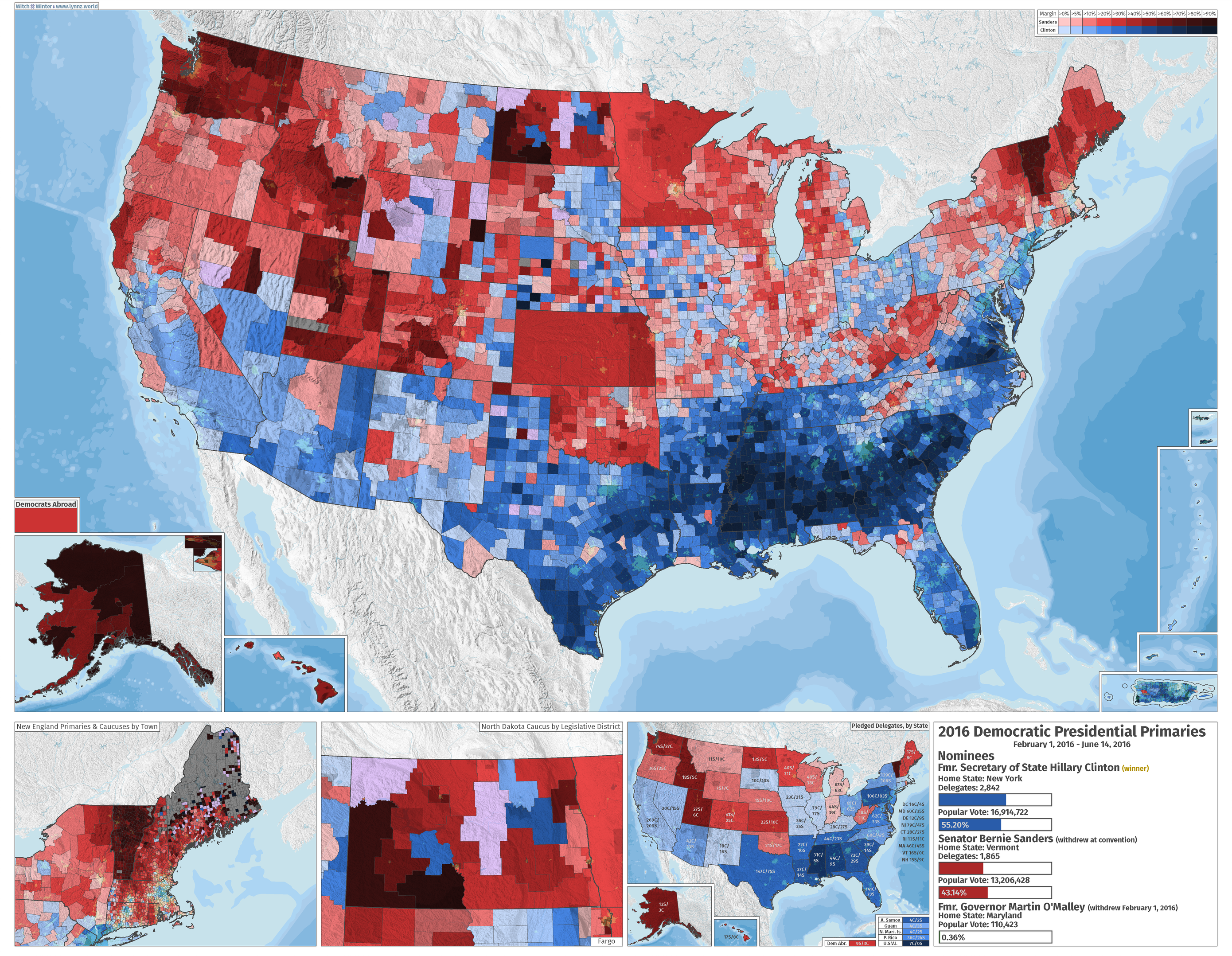
2016 Democratic Presidential Primary

Hello once again everyone!

With the 2020 Presidential primaries beginning to ramp up as so far 8 Democratic candidates have declared their candidacy for the primary of formed an exploratory committee, 1 is set to make an announcement this weekend, and over a dozen more are still on the table for consideration, I thought I would go back and look at the last Democratic Primary in 2016.

This one was an absolutely colossal primary pitting many core elements of the party against each other as Former Secretary of State and Senator Bernie Sanders vied for the nomination in a closer-than-expected campaign. While the party united behind Hillary after her eventual win, sore spots persist to this day, and are likely to come to the fore in 2020. In addition, elements of the party have continued to align themselves more towards the leftward vision of Sanders in 2016, which makes it likely that 2020 will see many similar elements from 2016 rear their heads again. Who they will align themselves for and how they will play out is unknown at this point in time, but I think it is of use to have a map of this sort as reference to better understand the changing Democratic Party and its regional allegiances found in the last Presidential primary, as so few primary maps do that justice.

Who will win 2020? Will it be someone claiming Clinton's coalition and legacy for their own, or someone who expands on Bernie's coalition to seize to the nomination? Perhaps Bernie himself, who is said to be likely to declare a run, will win the nomination this time, as Hillary or Reagan or Kennedy had to wait to win a primary. Only time will tell, though rest assured I will be here to map that as well, and compare the two when it's all over. Hopefully this map, until then, will serve as a useful reference and guide for the coming primary! Thank you to all readers, and enjoy.
Election season is once again upon us, and so, I have figured, why not get in on that action a little and combine my love of history and historical patterns in one big project for you all? I'm sure there is nothing controversial about politics, after all... So, to start off the month of October, I present to you all my project from September: A History of Democratic High Points, 1912-2012. The project seeks to, as the name implies, map out the high points by decade of the Democratic Party in the House of Representatives starting in 1912 and ending in 2012, as that was the highest mark for the Democrats in the House in the 2010s thus far.

Now, while the project has an obvious bent towards one party, that is not to say it is trying to favor one, so much as that as the Democrats controlled the House of Representatives for roughly 2/3 of the years of the 20th century, it makes for a more vivid picture to show the high points of that party and the way the party's coalition moved and changed in that time from a southern-based one to a hybrid and finally to an emerging new coalition that we are seeing in recent years. I do plan on a similar project for Republicans, but am currently mulling over a starting point, whether it would be better to start around the end of the Civil War or not, given the differences in how the parties separate themselves or not from their histories. Either way, I hope you all enjoy the project and no matter who you back this November, please remember to vote, as it is such a blessing that we enjoy.

(Also, hint, right click to open the images in their full size in your browser of choice.)

UPDATE: 2018 House of Representatives Elections


As of January 1, 2019, as I'm sure many of you know, the 2018 elections are now over and the Democratic Party has won back control of the House of Representatives. Following a couple special election wins and other special election results that were remarkably close, hearkening back to the 2009-10 special elections which favored Republicans, Democrats received a historic midterm election result. The Democratic Party won 235 seats, picking up 41 and making it their best year for pickups since the 1974 midterms post-Watergate. Democrats also won over 9.7 million more votes in an 8.6% margin of victory, making it not just the largest midterm margin for any party, but the largest margin of victory for a party in the minority on record. Turnout was also at a record high of 50.3% (2016 Presidential turnout was 55.7%), the highest for a midterm since 1914 and also a total reversal from the dismal 36.4% turnout in 2014, which had been the lowest for a midterm since 1942.

Due to a large number of retirements, both parties will have many freshmen entering Congress this January, some of whom have already made names for themselves such as Alexandria Ocasio-Cortez for the Democrats in New York's 14th district or Dan Crenshaw for the Republicans in Texas' 2nd district. What the future may hold for the freshmen is unknown, but there is much potential. Now as the nation turns itself towards 2020, many questions will be raised and how both parties adapt to them will determine the course of this nation's history. What is known, though, is that as the 2010s close the Democrats faced a difficult decade for their party often in the wilderness, but snatched victory from the jaws of defeat just at the end. How the Republican Party, still powerful in many ways, will react to this remains to be seen, but it for sure going to make the 2020s another interesting decade in the course of American life.

1912 House of Representatives Elections


The 1912 elections marked the first time since Grover Cleveland that there was not only a Democratic President, but that he would have a Democratic House to govern with. With the Republican Party rife with conflict over the fights between party hardliners and Progressives, led by Teddy Roosevelt, the Democrats were able to successfully position themselves as the party of stability and unity for the elections. In addition, 41 seats were added to the House of Representatives following the 1910 US Census, and many of them ended up in Democratic hands, particularly in growing southern states like Texas, which allowed the Democrats to increase their majority in the House—which they had gained back for the first time since 1894 in 1910—by 61 seats.

1922 House of Representatives Elections


The 1922 elections were the height of the Democratic Party for the 1920s, in what was marked as a rough decade for the Democratic Party that fought to find its footing and identity in a country that latched onto good feelings and postwar prosperity. However, that did not stop the Democrats from forcing Republicans into a narrow majority following the 1922 midterms in which continued division among the Republican ranks following the 1920 blowout (the highest point reached by the Republicans in the 20th century) between the conservatives and progressives as well as Republicans having to fight to hold on to a large number of marginal seats led to a large number of gains for Democrats: 76 all told. Not enough for a majority, but with the continued divisions and rise of factions like Senator LaFollette's Progressives and the birth of the populist offshoot Farmer-Labor Party, primarily concentrated in Minnesota, it made governing that much more difficult. The Socialists would also pick up a seat in Milwaukee, to round out the eclectic collection of parties for the era.

1936 House of Representatives Elections


This wave of elections, coming on the heels of Franklin Delano Roosevelt's record-setting victory for re-election as President, would be the zenith of Democrats not just in the 1930s, not just in the 20th century, but ever. At 334 out of 435 seats, Democrats controlled 76.78% of all total seats in the House of Representatives, a total they have not matched since and has only ever been surpassed by the 1866 Republicans with 78.125% in the midst of Reconstruction with not every state returning delegates. Bolstered by public faith in the New Deal, including the passing of the Social Security Act by the House in August 1935 by an overwhelming vote and a lack of Republican unity or organization against the Democratic coalition under FDR, the Democrats were virtually unstoppable. This election was also a high water mark for two major third parties of the era: the Progressive Party of Wisconsin and the Farmer-Labor Party of Minnesota. The Progressives managed to win 8 seats, including 1 outside their power base of Wisconsin all the way in San Francisco while the Farmer-Labor Party returned to their previous high point of 5 seats set in the 1930 midterms.

1940 House of Representatives Elections


After the nadir would, naturally, come the decline, and so the high point of the Democratic Party in the decade of the 1940s was in the very first year. Following a high number of losses in the 1938 midterms due to defending a large number of marginal seats as well as the 1937-38 recession, Democrats were once again boosted by Franklin D. Roosevelt as well as economic recovery following that very recession. This election was also notable as the last to occur during the Second World War but prior to the entry of the United States into the conflict, and one of the primary issues of day was the question of neutrality in that war. Ultimately, Roosevelt's resounding victory for an unprecedented third term and the Democratic recovery of several seats gave the party a mandate going into the fateful years of 1941-1943, which would prove to be some of the most world-changing in history. On another note, this was also the last election as of 2018 in which 6 parties were represented in Congress, and the beginning of the end for the Farmer-Labor Party and the Progressive Party. Many of the Progressives would end up rejoining the Republican Party just a few years later while the Farmer-Labor Party would strike a deal with Minnesota's Democratic Party to form the Minnesota Democratic Farmer-Labor Party (DFL for short) which stands to this day, and currently holds 5 of the state's 8 Congressional House seats, both of the state's U.S. Senators, the Governor's office, and minorities in Minnesota's House of Representatives and Senate.

1958 House of Representatives Elections


The next Democratic high point would not come until 18 years later, near the tail end of the Eisenhower era and a very changed world. By then, the Second World War had ended and the Republicans had taken back and lost the House twice during the tumultuous years after the death of Franklin D. Roosevelt and the Democratic Party's splintering and struggle to find its footing as a party of both segregation and unequal opportunity in the south and of liberalism and social justice in the north, as outlined by Hubert Humphrey's famous speech at the 1948 Democratic National Convention. The New Deal Coalition had been reconstructed and taken back the House in 1954, and Democrats would not hand it back until after the 1994 midterms' "Republican Revolution", 40 years later. The 1958 midterm was a tie for the second-largest gain in a single year for Democrats in the latter half of the 20th century, as unrest due to the 1958 recession and continued conflicts over civil rights, Cold War policy, and ongoing poverty and working rights caused a swelling of support for Democrats and led them to a very sizable majority in time for the fateful 1960 Presidential election.

1964 House of Representatives Elections


Following on the heels of the Civil Rights Act, the 1964 House elections would take the Democrats to the highest point they had experienced since the 1936 elections 28 years earlier, and a height that the party has not again reached as of this writing. The elections were cast as part of the tumultuous and bitterly-fought 1964 Presidential Campaign by President Lyndon B. Johnson, who had assumed the role following the assassination of President Kennedy in November 1963, and conservative firebrand Barry Goldwater. While the ultimate election was a massive wipeout for Goldwater and the Republicans in both the Presidential ticket and in the House, there were signs of a shift in the electorate. Barry Goldwater won 5 states in the Deep South which had been drifting around various third parties up until that point rather than vote Democrat (most of the time), and Lyndon B. Johnson won the rock-ribbed Republican states of Maine and Vermont, the latter of which had never voted for a Democrat in any election in its history; the last election in which it had not voted Republican being 1852 in which the state had voted for Whig candidate Winfield Scott. In the House elections the shifts geographically were not quite as immediate so much as retaking lost seats despite a steady erosion of the New Deal Coalition, but there still was, for the first time since Reconstruction, the matter of Republicans winning seats in the Deep South including a majority of seats in Alabama while Democrats picked up strength not seen in many decades in areas such as New England, Upstate New York, and suburban Detroit. This large mandate would give President Johnson the power to enact policies such as his Great Society programs and the Voting Rights Act, even though a certain war in Southeast Asia would leave the policy decisions decided in Congress far less remembered from the era.

1976 House of Representatives Elections


Though the 1974 midterm elections are the more famously remembered elections of the 1970s for election nerds, the high point for Democrats in that decade would actually come two years later, just narrowly, with a single-seat gain in the House on the coattails of Jimmy Carter's election to President as a more conservative answer to the country's call for a Democratic President after the Watergate scandal and subsequent loss of respect for President Nixon during the Ford years as the party stumbled its way to try and find what sort of party it wanted to be after the stunning loss of the far leftier (than Carter) McGovern in 1972. The 1976 House elections would show the last full strength of the Democratic post-New Deal coalition of minority and working-class white voters, with it being the last in which any one party won a veto-proof majority in the House. The Watergate Babies of 1974 were still playing a major role in this election as well, and the result would help create the modern Democratic Party those of us in the United States know today. This election would also mark the retirement of House Majority Leader Carl Albert and the rise of famed Speaker of the House Tip O'Neill, who held the position from 1977-1987 as the Speaker with the most years served in a row and the third-longest serving Speaker overall.

1982 House of Representatives Elections


In 1980, Reaganism and its effect on the electorate got its biggest effect yet as the country was much changed from the place it had been six years before. The 1980 House elections had brought Republicans into striking distance of a House majority for the first time in 30 years, but Reagan's early polarization brought trouble and it was a struggle for Republicans going into the election. In addition, "boll weevil" Democrats in the south who would vote alongside the President who was popular with constituents on certain issues were able to campaign on those votes to retain seats that might have otherwise been lost, limiting how many districts the Republicans could plausibly win, particularly in a midterm year. Finally, a recession 1982 only further brought stress to freshman Republicans in newly-won seats, and many of those who had risen on the coattails of Reagan in 1980 would not make it past 1982 as Democrats carried themselves to a comfortable majority and the highest point in the 1980s—though the low point following 1982 would not again get quite as close as the low point of 1980. Notably, no less than 3 candidates for President were elected as freshmen in 1982, and 1 of them past the primary: John McCain (R-AZ), John Kasich (R-OH), and Bill Richardson (D-NM).

1990 House of Representatives Elections


The 1990 House elections, the highest point of what would prove to be a very tumultuous decade for the Democratic Party, was one that was ultimately defined less by the election itself and more by what it meant for what came after. The successful ability for Democrats to hold onto the House of Representatives, in large part thanks to favorable maps drawn in 1981 that by 1990 had produced many barely-competitive or noncompetitive races, allowed them to hold Bush to favorable agenda while also winning many other elections in that midterm such as control of state governments across important states like Texas and Florida. This would result in some of the most infamous gerrymandering yet seen in American politics as Democrats would redraw districts to hold onto as many districts in the south as they possibly could, and result in several court-ordered redistrictings and being stretched thinly enough for a breakdown of the Post-New Deal Coalition all together in 1994. In addition, 1990 would result in Republicans pressing for more enforcement of the Voting Rights Act in alliance with minority groups to force Democrats to draw more majority-minority districts, preventing the common practice of spreading minorities out to combine them with Democratic whites across the south for more pro-Democratic districts. 1990, thus, was a minor election with far larger consequences for the future. One other notable mention is the election of Bernie Sanders to Vermont's At-Large district as the first non-Republican and non-Democrat elected to Congress in decades (though followed during the 90s by several others) and the first non-Republican to hold the seat since 1958's election. The seat has not since been held by a Republican.

2008 House of Representatives Elections


Following a difficult decade in the wilderness for the Democratic Party following the 1994 losses, the party had managed to come back into a majority in the 2006 midterms under President George Bush under a myriad of issues including scandals, political corruption, and opposition to the ongoing War in Iraq and War in Afghanistan. Then, by 2008, the economic fortunes of the United States had collapsed into what would become nicknamed as the "Great Recession" and the President's once-meteoric approval ratings were the lowest of virtually any modern President. Thus, the high point of the Democratic Party, which had just 6 years before managed to lose a midterm in one of the few times it has been done, would occur in 2008. Though the Republican Party was not without gains of its own due to continued shifts in the electorates of both parties, the further 21 net gains of the Democrats in this election put the Democrats just 1 seat behind where they had been after the 1992 elections 16 years before on the election of Bill Clinton. The elections coincided with the election of Barack Obama, Senator from Illinois, and Democrats rode his coattails in his Midwestern gains in states such as Ohio, Michigan, and Illinois. For the first time since the Antebellum period, Republicans held no seats in New England and for the first time in decades Democrats held most (or all) of the seats in the western states of Colorado, Arizona, New Mexico, and Nevada. Similarly, this was a first high point in which Democrats reached a large majority while still losing a majority of House seats in Texas and also managed to win only 1 seat in Louisiana. This alignment would continue in force into the 2010s to this day.

2012 House of Representatives Elections


Thus far in the 2010s, 2012 has remained the high point for Democrats in this decade. Though not a majority in the House, it is the last time that Democrats gained over 200 seats and the last time the Democrats won the popular vote (though through a plurality and not actual majority). This was the election in which Democrats once again riding on the coattails of a hoped-for Obama wave had to contend with a high number of incumbent Republicans recently elected following the Tea Party wave in 2010 and redistricting drawn after the 2010 US Census that was later ruled in a handful of states to favor Republicans (not that Democrats have not done the exact same thing when given the chance, as I have pointed out, mind). The result was ultimately mixed, with Democrats retaining some tricky seats such as West Virginia's 3rd Congressional District and New York's 21st Congressional District in the far north of the state (won by a Democrat as the 23rd in a special election in 2009 that saw the area of the district fall to a non-Republican for the first time since 1873) while losing others. Democrats for the second time won every single district in New England, a feat which as of this writing on October 1, 2018, has not been repeated. Ultimately, Democrats gained 8 seats and fell 17 short of a majority while holding onto the Presidency and gaining 2 seats in the Senate.

For those of us now, a little more than a month out of the 2018 elections, this remains the largest Democratic high of the past decade. Will it be broken? Will Democrats finally gain a majority this decade? Will the Trump coalition and the record-high voter enthusiasm prove too hard a shore for the blue wave to crash against? Only time will tell. Until then, this is what we have, and I hope you all enjoyed this project of mine. If Democrats do indeed break this record (to do so they will need to gain 8 seats), I will make an overly-detailed midterm map and post it after the elections. If not...I'll probably still post a map because it's a trending topic these days. Take care, all, and remember to vote! Oh, and a bonus...

1992 House of Representatives Elections


This map is more of a bonus thing, just to show the beast created in response to winning the 1990 midterms and the advent of computer technology to gerrymandering. Democrats took every advantage they had from 1990 to hold onto as many seats as they could and created what are to this day some of the nastiest gerrymanders one could see, particularly in Texas where infamously the district boundaries could go down to neighborhood level (or so I was told, growing up there). The election coincided with the "Year of Women" and Arkansas Governor Bill Clinton's election to the Presidency, but the enforcement of the VRA on redistricting and the counters by Republican-held states with districts of their own as well as the lack of an overwhelming victory by Clinton at the popular vote level helped lead to an overall lose of seats for Democrats, which would help set up the anger and popular discontent to sow the seeds for the Republican Revolution in 1994 that would so radically change American politics to this day.

Citations

Jeffrey B. Lewis, Brandon DeVine, Lincoln Pitcher, and Kenneth C. Martis. (2013) Digital Boundary Definitions of United States Congressional Districts, 1789-2012. Retrieved from http://cdmaps.polisci.ucla.edu on 2 September, 2018.

Oreskes, Michael. “The 1990 Elections: The Future - Redistricting; Elections Strengthen Hand of Democrats In '91 Redistricting.” The New York Times, The New York Times, 8 Nov. 1990, www.nytimes.com/1990/11/08/us/1990-elections-future-redistricting-elections-strengthen-hand-democrats-91.html.

Other information retrieved from http://www.en.wikipedia.org and https://www.ourcampaigns.com/  on 2 September, 2018 through 1 October, 2018.


The Yoop


Here is a map for a larger project I've been developing with a friend about an alternate United States and its politics, culture, and world. As a little preview, I thought I would publish a map of one of the 54 United States: Superior. This map is a little bit of practice for larger maps, hope you all like it, and expect more soon!

Superior is one of the newest states in the union, and also the smallest by population at just over 300,000. The state gained statehood through referendum that was decided by a Supreme Court decision, due to movements for an independent Upper Peninsula of Michigan over increased ties with Wisconsin, delays at the time on building a bridge to link it with the Lower Peninsula, and more control over the locks linking the lower lakes with Lake Superior, through which massive quantities of iron and oil travel through. Since then, Superior has maintained close ties between itself and Michigan as well as with Wisconsin and cross-border ties with Canada, making the state one of the most travel-friendly in the union. The completion of a bridge across the Straits of Mackinac and the extension of an interstate up to the state capital of Marquette have helped connect Superior with the rest of the country, even if the state remains largely rural. The state is still a favorite by the lakes and hills in the summer and by the many holiday resorts in the winter.